Friday, 15 December 2017

Stoke-on-Trent Buy-to-Let Return / Yields – 3.2% to 10.1% a year

The mind-set and tactics you employ to buy your first Stoke-on-Trent buy to let property needs to be different to the tactics and methodology of buying a home for yourself to live in. The main difference is when purchasing your own property, you may well pay a little more to get the home you (and your family) want, and are less likely to compromise. When buying for your own use, it is only human nature you will want the best, so that quite often it is at the top end of your budget (because as my parents always used to tell me – you get what you pay for in this world!).

 
Yet with a buy to let property, if your goal is a higher rental return – a higher price doesn’t always equate to higher monthly returns – in fact quite the opposite. Inexpensive Stoke-on-Trent properties can bring in bigger monthly returns. Most landlords use the phrase ‘yield’ instead of monthly return. To calculate the yield on a buy to let property one basically takes the monthly rent, multiplies it by 12 to get the annual rent and then divides it by the value of the property.
 
This means, if one increases the value of the property using this calculation, the subsequent yield drops. Or to put it another way, if a Stoke-on-Trent buy to let landlord has the decision of two properties that create the same amount of monthly rent, the landlord can increase their rental yield by selecting the lower priced property.
 
To give you an idea of the sort of returns in Stoke-on-Trent...
 
Stoke-on-Trent Property type
Average Price paid (last 12 months) in Stoke-on-Trent
Average Rent Achieved in last 12 months in Stoke-on-Trent
Lower End of Yield Range in Stoke-on-Trent
Average Yield in Stoke-on-Trent
Upper End of Yield range in Stoke-on-Trent
Detached
£222,860
£856
3.23%
4.61%
5.45%
Semi-Detached
£128,590
£567
4.43%
5.29%
7.11%
Terraced
£88,343
£532
5.99%
7.23%
10.14%
Flats
£83,254
£462
5.28%
6.66%
7.61%
 
Now of course these are averages and there will always be properties outside the lower and upper ranges in yields: they are a fair representation of the gross yields you can expect in the Stoke-on-Trent area.
 
As we move forward, with the total amount of buy to let mortgages amounting to £199,310,614,000 in the country, landlords need to be aware of the investment performance of their property, especially in the era of tax increases and tax relief reductions. Landlords are looking to maximise their yield - and are doing so by buying cheaper properties.
 
However, before everyone in Stoke-on-Trent starts selling their upmarket properties and buying cheap ones, yield isn’t the only factor when deciding on what Stoke-on-Trent buy to let property to buy.  Void periods (i.e. the time when there isn’t a tenant in the property between tenancies) are an important factor and those properties at the cheaper end of the rental spectrum can suffer higher void periods too. Apartments can also have service charges and ground rents that aren’t accounted for in these gross yields. Landlords can also make money if the value of the property goes up and for those Stoke-on-Trent landlords who are looking for capital growth, an altered investment strategy may be required.
 
In Stoke-on-Trent, for example, over the last 20 years, this is how the average price paid for the four different types of Stoke-on-Trent property have changed…

  • Stoke-on-Trent Detached Properties have increased in value by 218.6% 
  • Stoke-on-Trent Semi-Detached Properties have increased in value by 222.2%
  • Stoke-on-Trent Terraced Properties have increased in value by 223.3%
  • Stoke-on-Trent Apartments have increased in value by 228.5%
It is very much a balancing act of yield, capital growth and void periods when buying in Stoke-on-Trent. Every landlord’s investment strategy is unique to them. If you would like a fresh pair of eyes to look at your portfolio, be you a private landlord that doesn’t use a letting agent or a landlord that uses one of my competitors – then feel free to drop in and let’s have a chat. What have you got to lose? 30 minutes and my tea making skills are legendary!

Friday, 8 December 2017

42.4% Drop in Stoke on Trent People Moving Home in the Last 10 Years


I was having a lazy Saturday morning, reading through the newspapers at my favourite coffee shop in Stoke on Trent.  I find the most interesting bits are their commentaries on the British Housing Market.  Some talk about property prices, whilst others discuss the younger generation grappling to get a foot-hold on the property ladder with difficulties of saving up for the deposit.  Others feature articles about the severe lack of new homes being built (which is especially true in Stoke on Trent!).  A group of people that don’t often get any column inches however are those existing homeowners who can’t move!

Back in the early 2000’s, between 1m and 1.3m people moved each year in England and Wales, peaking at 1,349,306 home-moves (i.e. house sales) in 2002.  However, the ‘credit crunch’ hit in 2008 and the number of house sales fell to 624,994 in 2009.  Since then this has steadily recovered, albeit to a more ‘respectable’ 899,708 properties by 2016.  This means there are around 450,000 fewer house sales (house-moves) each year compared to the noughties.  The question is ... why are there fewer house sales?


To answer that, we need to go back 50 years.  Inflation was high in the late 1960’s, 70’s and early 80’s.  To combat this, the Government raised interest rates to a high level in a bid to lower inflation. Higher interest rates meant the householders monthly mortgage payments were higher, meaning mortgages took a large proportion of the homeowner’s household budget. However, this wasn’t all bad news since inflation tends to erode mortgage debt in ‘real spending power terms’.  Consequently, as wages grew (to keep up with inflation), this allowed home owners to get even bigger mortgages.  At the same time their mortgage debt was decreasing, therefore allowing them to move up the property ladder quicker.

Roll the clock on to the late 1990’s and the early Noughties, and things had changed.  UK interest rates tumbled as UK inflation dropped.  Lower interest rates and low inflation, especially in the five years 2000 to 2005, meant we saw double digit growth in the value of UK property.  This inevitably meant all the home owner’s equity grew significantly, meaning people could continue to move up the property ladder (even without the effects of inflation).

This snowball effect of significant numbers moving house continued into the mid noughties (2004 to 2007), as Banks and Building Society’s slackened their lending criteria.  [You will probably remember the 125% loan to value Northern Rock Mortgages that could be obtained with just a note from your Mum!!].  This  meant home movers could borrow even more to move up the property ladder.
So, now it’s 2017 and things have changed yet again!

You would think that with ultra-low interest rates at 0.25% (a 320-year low) the number of people moving would be booming – wouldn’t you?  However, this has not been the case.  Less people are moving because:

(1) low wage growth of 1.1% per annum

(2) the tougher mortgage rules since 2014

(3) sporadic property price growth in the last few years

(4) high property values comparative to salaries (I talked about this a couple of months ago)

 What does this translate to in pure numbers locally?

In 2007, 6,230 properties sold in the Stoke on Trent City Council area and last year, in 2016 only 3,584 properties sold – a drop of 42.47%.

Therefore, we have just over 2,645 less households moving in the Stoke on Trent and surrounding Council area each year.  Now of that number, it is recognised throughout the property industry around fourth fifths of them are homeowners with a mortgage. That means there are around 2,170 mortgaged households a year (fourth fifths of the figure of 2,645) in the Stoke on Trent and surrounding council area that would have moved 10 years ago, but won’t this year.

The reason they can’t/won’t move can be split down into different categories, explained in a recent report by the Council of Mortgage Lenders (CML). So, of those estimated 2,170 annual Stoke on Trent (and surrounding area) non-movers, based on that CML report -


  1. There are around 781 households a year that aren’t moving due to a fall in the number of mortgaged owner occupiers (i.e. demographics).
  2. I then estimate another 304 households a year are of the older generation mortgaged owner occupiers. As they are increasingly getting older, older people don’t tend to move, regardless of what is happening to the property market (i.e. lifestyle).
  3. Then, I estimate 130 households of our Stoke on Trent (and surrounding area) annual non-movers will mirror the rising number of high equity owner occupiers, who previously would have moved with a mortgage but now move as cash buyers (i.e. high house price growth).
  4. I believe there are 955 Stoke on Trent (and surrounding area) mortgaged homeowners that are unable to move because of the financing of the new mortgage or keeping within the new rules of mortgage affordability that came into play in 2014 (i.e. mortgage).

The first three above are beyond the Government or Bank of England control.  However could there be some influence exerted to help the non-movers because of financing the new mortgage and keeping within the new rules of mortgage affordability? If Stoke on Trent property values were lower, this would decrease the size of each step up the property ladder.  This would mean the opportunity cost of increasing their mortgage would reduce (i.e. opportunity cost = the step up in their mortgage payments between their existing and future new mortgage) and they would be able to move to more upmarket properties.

Then there is the mortgage rules, but before we all start demanding a relaxation in lending criteria for the banks, do we want to return to free and easy mortgages 125% Northern Rock footloose and fancy-free mortgage lending that seemed to be available in the mid 2000’s ... available at a drop of hat and three tokens from a cereal packet?

We all know what happened with Northern Rock …. Your thoughts would be welcome on this topic.


Friday, 1 December 2017

Decreasing Numbers of Younger Homeowners in Stoke on Trent

Richard Graham, 36-year-old father of two from Stoke on Trent, was out house hunting. It was a pleasant August Saturday afternoon, and our man cycles along on his bike. He cycles up a street of suburban semis, where he spots a few retired mature neighbours, chatting to each other over the garden fence. He leans his bicycle against a lamppost and launches softly into his property search.

 Anyone on the road contemplating moving?” Richard asks, “I am not a landlord or developer, I’m just a Stoke on Trent bloke trying to get out of renting, buy a house, do it up and live in it with my wife and two children

 The only way I will leave here is in a box”, answers an 80-something lady, wearing her fading Paisley patterned housecoat from the 1970’s.

 I‘ve lived here since before you were born, its lovely up here .. we aren’t moving, are we Doris?” (as her neighbour sagely shook his head at his wife).

Richard, like many Stoke on Trent people born in the late 1970’s to the early 1990’s, is keen to get a slice of prime Stoke on Trent real estate. Yet people like Richard in Generation Y (or the Millennials as some people call them i.e. born between 1977 and 1994 and needing family housing now) are discovering, as each year passes by, they are becoming more neglected and ignored when it comes to moving up the property ladder.

Looking at the graph for the UK as whole …

Over 75 percent of Brits aged 65 and above (the baby boomers) are owner-occupiers, the biggest share since records began and a proportional rise of over 48.3% since the early 1980’s. Looking at those Baby Boomers (the current 65+year olds)  .. and roll the clock back 36 years (to when they were in their 30’s and 40’s and two thirds (65.6%) of them owned their own home.

Whilst today, just under a half of 25 to 49 year olds (47.3%) own their own home.

However, the biggest drop has been in the 18 to 24-year old’s, where homeownership has dropped from a third (32%) in the 1980’s to less than one in ten (8.9%) today. Looking at the Stoke on Trent statistics, the numbers make even more interesting reading.


Government policy contributes to the generational stalemate. Stamp Duty rules prevent older Brits from moving as the price of land and planning rules make it harder to build affordable bungalows that are attractive to members of the older generation who want to move.

The average value of an acre of prime building land in the UK is between £750,000 and £800,000 per acre. Bungalows are the favoured option for the older generation, but the problem is bungalows take up too much land to make them profitable for new homes builders. The housing market is gridlocked with youngsters wanting to get on (then move up) the property ladder whilst the older generation, who want to move from their larger houses to smaller, more modern bungalows, can’t. The problem is – there simply aren’t enough bungalows being built and the high price of land, means they are prohibitive to build.

So, what is my point? Well, all I would say to the homeowners of Stoke on Trent is that one solution could be to start to talk to your local councillors, so they can mould the planners’ thoughts and the local authority thinking in setting land aside for bungalows instead of two up two down starter homes? That would free the impasse at the top of the property ladder (i.e. mature people living in big houses but unable to move anywhere), releasing the middle aged gridlocked people in the ladder to move up, thus releasing more existing starter homes for the younger generation.   

 … and to you Richard … the wandering new home searcher – if things are going to change, it will be years before they do .. so keep going out and spreading the word of your search for a new home for your family.

Tuesday, 14 November 2017

Stoke on Trent’s New 3 Speed Property Market

“What’s happening to the Stoke on Trent Property Market” is a question I am asked repeatedly.  Well, would it be a surprise to hear that my own research suggests that there isn’t just one big Stoke on Trent property market – but many small micro-property markets?

According to recent data released by the Office of National Statistics (ONS), I have discovered that at least three of these micro-property markets have emerged over the last 20+ years in the town.
For ease, I have named them the …
  1. lower’ Stoke on Trent Property Market.
  2. lower to middle’ Stoke on Trent Property Market.
  3. ‘middle’ Stoke on Trent Property Market.
The ‘lower’ and ‘lower to middle’ sectors of the Stoke on Trent property market have been fuelled over the last few years by two sets of buyers. The first set, making up the clear majority of those buyers, are cash rich landlord investors who are throwing themselves into the Stoke on Trent property market to take advantage of alluringly low prices and even lower interest rates. The other set of buyers in the ‘lower’ and ‘lower to middle’ Stoke on Trent property market are the first-time buyers (FTB), although the FTB market is in a state of unparalleled deadlock as it’s been trampled into near-immobility and incapacity by the new 2014 stricter mortgage affordability regulations and also fewer mortgages with low deposits. 
Some of you may be interested to know how I have classified the three sectors ..
  1. lower’ Stoke on Trent housing market – the bottom 10% (in terms of value) of properties sold
  2. lower to middleStoke on Trent housing market – lower Quartile (or lowest 25% in terms of value) of properties sold
  3. middle’ Stoke on Trent housing market - which is the median in terms of value
 …. and if one looks at the figures for Stoke on Trent City Council area you can see the three different sectors (lower, lower/middle and middle) have performed quite differently.
 
Stoke on Trent City Council Property Market – Sold Prices
Price Paid in 1995
Price Paid in 2017
Percentage Uplift
1995 - 2017
Lower (Bottom 10%)
£15,000
£55,000
266.67%
Lower to Middle (Lower Quartile)
£22,000
£72,500
229.55%
Middle (The Median)
£33,752
£112,865
234.40%
 
You can quite clearly see that it is the ‘lower’ market that has performed the best.
You might ask, what do all these different figures mean to homeowners and landlords alike?  Quite a lot – so let me explain. The worst performing sector (with the lowest Percentage uplift) was the ‘lower to middle’ housing market. Therefore, interestingly, if we applied the best percentage uplift figure (i.e. from the ‘lower’ market percentage uplift), to the ‘lower to middle’ 1995 housing market figure, the 2017 figure of £72,500, would have been £80,667 instead – quite a difference you must agree?

Now, I have specifically not mentioned the upper reaches of the Stoke on Trent housing market for several reasons.  Firstly, the lower or middle market is where most of the buy to let investment landlords buy their property and where the majority of property transactions take place. Secondly, due to the unique and distinctive nature of Stoke on Trent’s up-market property scene (because every property is different and they don’t tend to sell as often as the lower to middle market), it is much more difficult to calculate what changes have occurred to property prices in that part of the Stoke on Trent property market - looking at the stats for the up-market Stoke on Trent property market from Land Registry, only 28 properties in Stoke on Trent (and a 5 mile radius around it) have sold for £1,000,000 or more since 1997.

So, what should every homeowner and buy to let landlord take from the information that there are many micro-property markets? Well, when you realise there isn’t just one Stoke on Trent Property Market, but many Stoke on Trent “micro-property markets”, you can spot trends and bag yourself some potential bargains. Even in this market, I have spotted a number of bargains over the last few months that I have shared in my Property Blog and to my landlord database, especially in the ‘lower’ and ‘lower/middle’ market.


If you want to be kept informed of those buy to let bargains, keep an eye on my regular blog updates, it’s free to do so and I’m sure you wouldn’t want to miss out – would you?  If you see anything of interest, please give us a call on 01782 262880.


Saturday, 11 November 2017

Stoke-on-Trent Homeowners and their £2.57 billion Debt

Over the last 12 months, the UK has decided to leave the EU, have a General Election with a result that didn’t go to plan for Mrs May and to add insult to injury, our American cousins elected Donald Trump as the 45th President of the United States. It could be said this should have caused some unnecessary unpredictability into the UK property market.

The reality is that the housing and mortgage market (for the time being) has shown a noteworthy resilience. Indeed on the back of the Monetary Policy pursued by the Bank of England there has been a notable improvement of macro-economic conditions! In July for example it was announced that we are witness to the lowest levels of unemployment for nearly 50 years. Furthermore, despite the UK construction industry building 21% more properties than same time the previous year, there has still been a disproportionate increase in demand for housing, particularly in the most thriving areas of the Country. Repossessions too are also at an all-time low at 3,985 for the last Quarter (Q1 2017) from a high of 29,145 in Q1 2009. All these things have resulted in...

Property values in Stoke-on-Trent according to the
Land Registry are 3.1% higher than a year ago

So, what does all this mean for the homeowners and landlords of Stoke-on-Trent, especially in relation to property prices moving forward?

One vital bellwether of the property market (and property values) is the mortgage market. The UK mortgage market is worth £961,653,701,493 (that’s £961bn) and it representative of 13,314,512 mortgages (interestingly, the UK’s mortgage market is the largest in Europe in terms of amount lent per year and the total value of outstanding loans). Uncertainty causes banks to stop lending – look what happened in the credit crunch and that seriously affects property prices.

Roll the clock back to 2007, and nobody had heard of the term ‘credit crunch’, but now the expression has entered our everyday language.  It took a few months throughout the autumn of 2007, before the crunch started to hit the Stoke-on-Trent property market, but in late 2007, and for the following year and half, Stoke-on-Trent property values dropped each month like the notorious heavy lead balloon, meaning …
The credit crunch caused Stoke-on-Trent property values to drop by 19.3%
Under the sustained pressure of the Credit Crunch, the Bank of England realised that the UK economy was stalling in the early autumn of 2008. Loan book lending (sub-prime phenomenon) in the US and across the world was the trigger for this pressure. In a bid to stimulate the British economy there were six successive interest rates drops between October 2008 and March 2009; this resulted in interest rates falling from 5% to 0.5%!

Thankfully, after a period of stagnation, the Stoke-on-Trent property market started to recover slowly in 2011 as certainty returned to the economy as a whole and Stoke-on-Trent property values really took off in 2013 as the economy sped upwards. Thankfully, the ‘fire’ was taken out of the property market in Spring 2015 (otherwise we could have had another boom and bust scenario like we had in the 1960’s, 70’s and 80’s), with new mortgage lending rules. Throughout 2016, we saw a return to more realistic and stable medium term property price growth. Interestingly, property prices recovered in Stoke-on-Trent from the post Credit Crunch 2009 dip and are now 17.2% higher than they were in 2009.
Now, as we enter the summer of 2017, with the Conservatives having been re-elected on their slender majority, the Stoke-on-Trent property market has recouped its composure and in fact, there has been some aggressive competition among mortgage lenders, which has driven mortgage rates down to record lows. This is good news for Stoke-on-Trent homeowners and landlords, over the last few months a mortgage price war has broken out between lenders, with many slashing the rates on their deals to the lowest they have ever offered.  For example, last month, HSBC launched a 1.69% five-year fixed mortgage!
Interestingly, according to the Council of Mortgage Lenders, the level of mortgage lending had soared to an all-time high in the UK. 

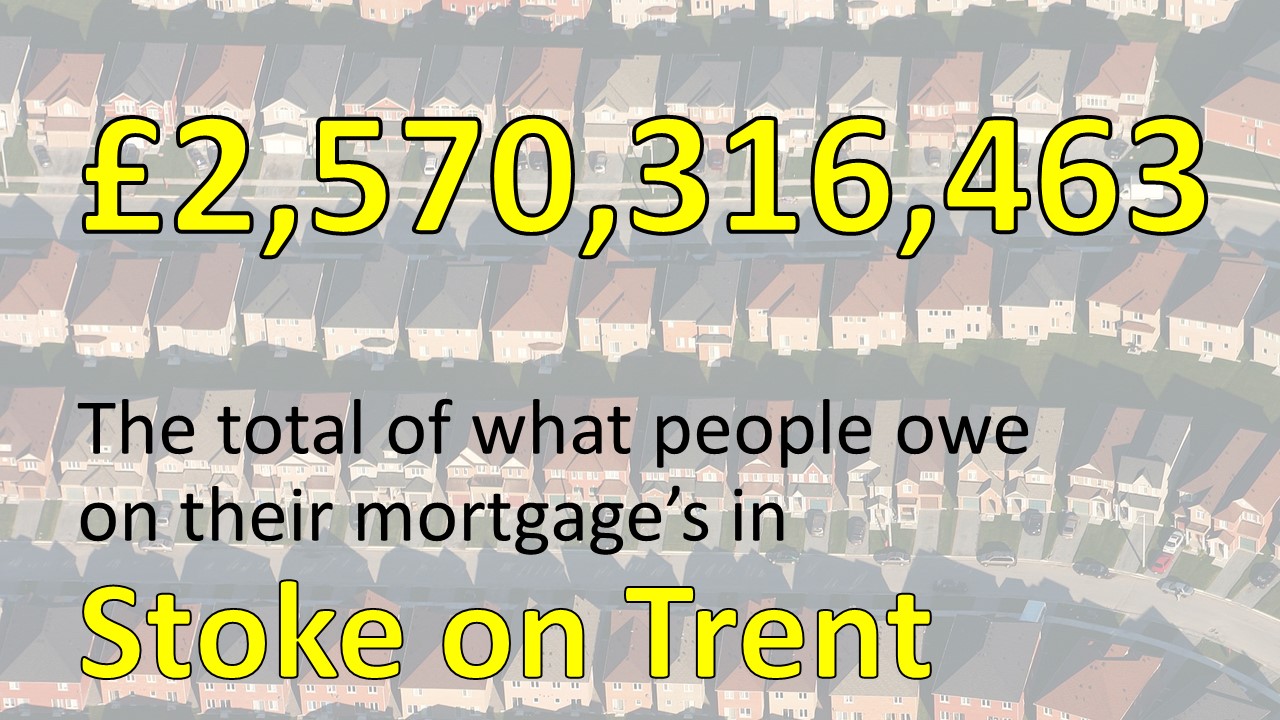
In the Stoke-on-Trent postcodes of ST1 to ST4, ST6 & ST9, if you added up everyone’s mortgage, it would total £2,570,316,463!

Since 1977, the average Bank of England interest rate has been 6.65%, making the current 323 year all time low rate of 0.25% very low indeed. Thankfully, the proportion of borrowers fixing their mortgage rate has gone from 31.52% in the autumn of 2012 to the current 59.3%. If you haven’t fixed – maybe you should follow the majority?

In my modest opinion, especially if things do get a little rocky and uncertainty seeps back in the coming years (and nobody knows what will happen on that front), one thing I know is for certain, interest rates can only go one way from their 300 year ultra 0.25% low level ... and that is why I consider it important to highlight this to all the homeowners and landlords of Stoke-on-Trent. Maybe, just maybe, you might want to consider taking some advice from a qualified mortgage adviser? There are plenty of them in Stoke-on-Trent.
If you are interested in the Stoke-on-Trent Property Market, please have a look at my other blogs on the subject, or give us a call on 01782 262880 for help and advice